
Italian Journal. 4.
The National Archaeological Museum of Naples

Friday, November 7
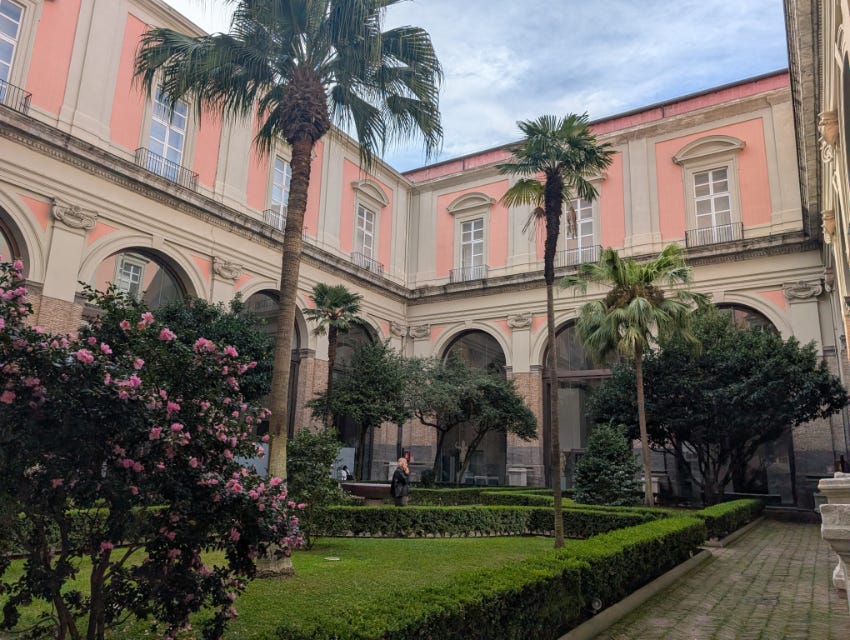
We went to the National Archaeological Museum today. It’s nearby, an easy walk. And it’s vast. Too much. The building itself is large and really beautiful, with lovely courtyards where we sat when we needed to take a break.
There are only so many Roman sculptures and portrait heads that I can absorb at one time, although I was pretty fascinated to see portraits of many Greek philosophers and writers — all were Roman copies of Greek originals. Did they really look like this? Perhaps — each one is entirely individual.
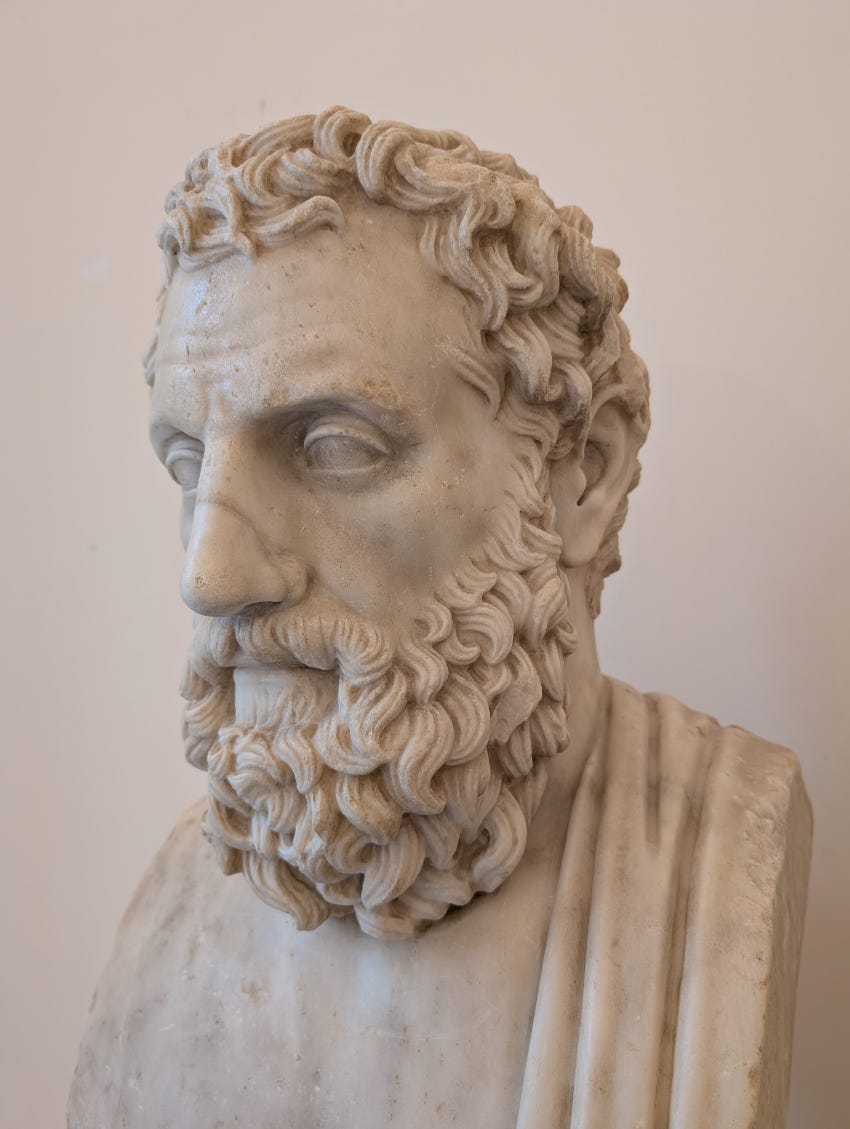
Bust of Aeschylus. Pentelic marble from Greece; Roman copy of Greek original of 340-330 B.C.
Most interesting to me were the Roman mosaics from Pompeii and the wall paintings from Pompeian villas. These works are very skilled, detailed, and human — the physiognomies reminded me of Egyptian funerary portraits — with knowledge of perspective and modelling as well as interesting ways of representing space and time, as in some paintings showing different scenes of the Trojan War in different parts of the same panel.
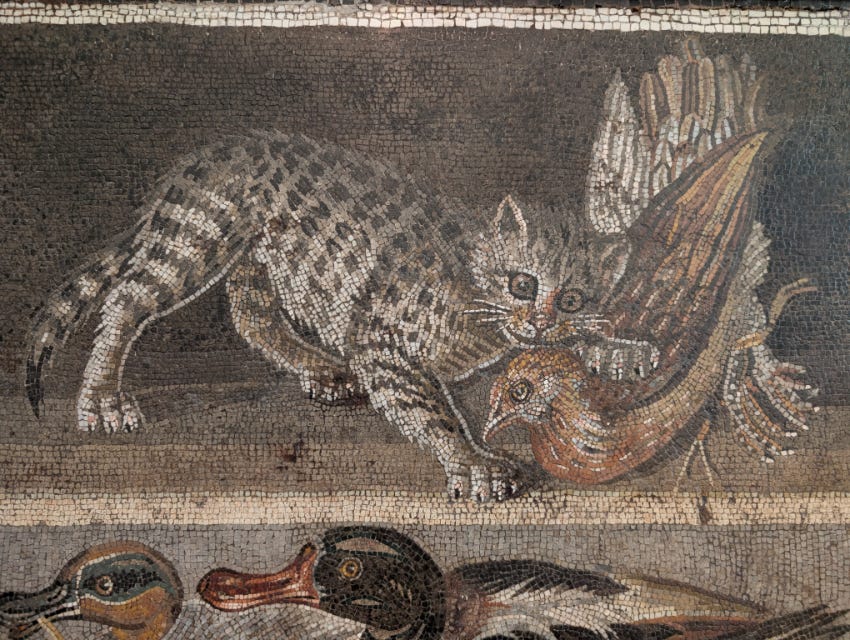
A fine cat mosaic from Pompeii, with ducks swimming below.
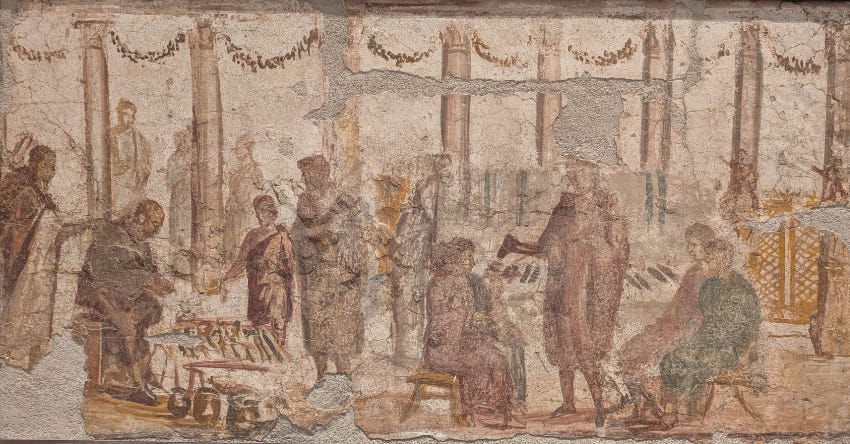
I was very surprised to see some “sketches”: wall paintings of market/forum scenes done in a very loose, brush-y style that would be at home in any modern travel sketchbook.
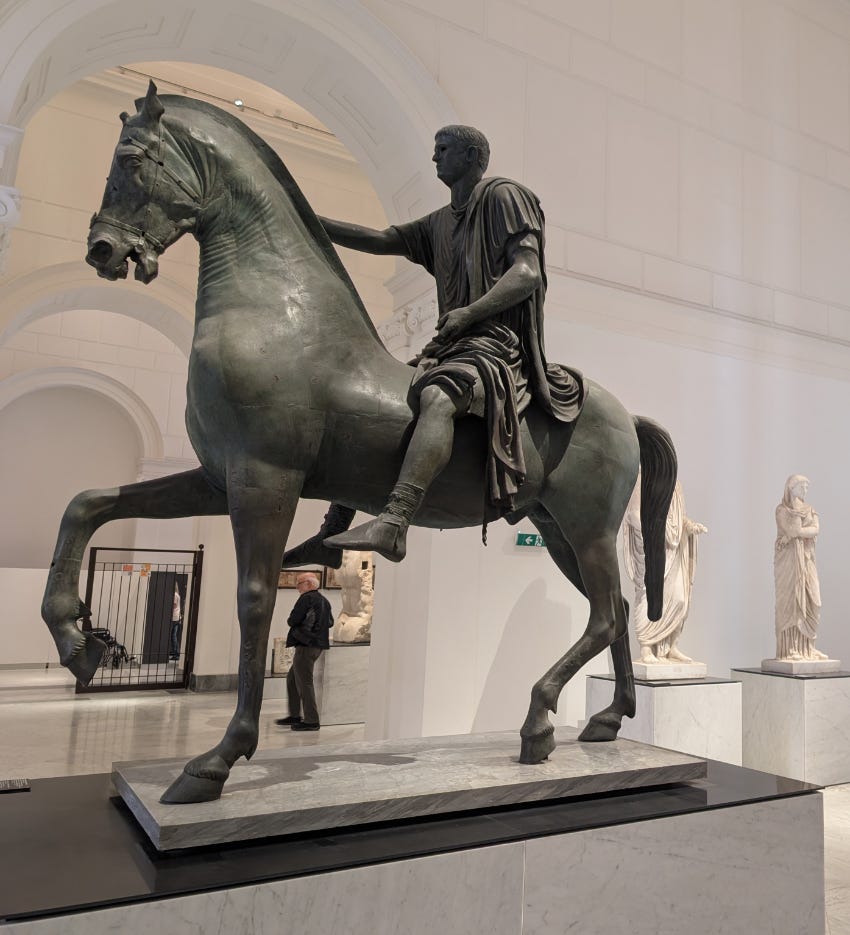
The Romans really loved their horses.
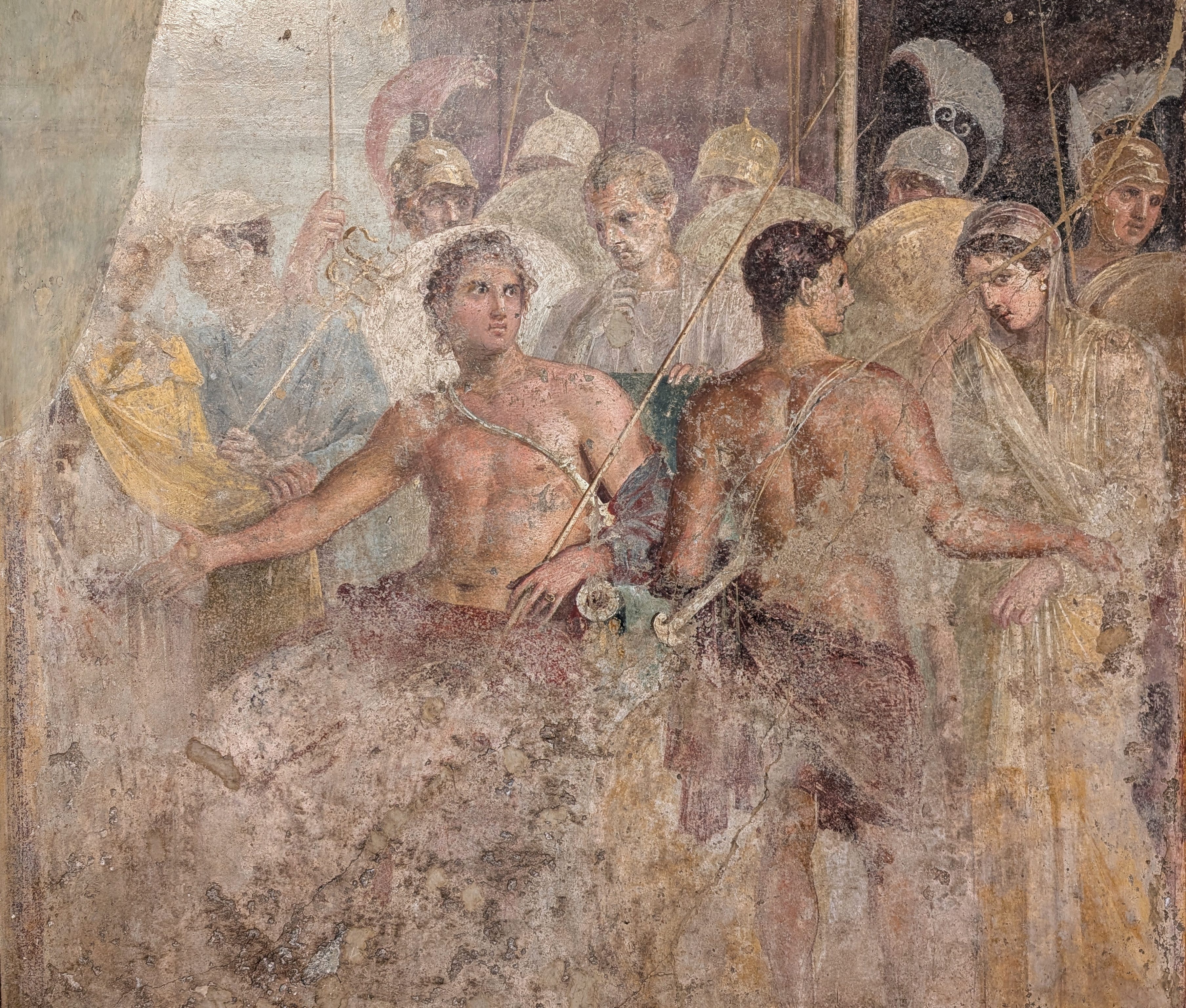
I’ve been thinking about a few works in particular. One was a painting of Achilles giving up his mistress, Briseis, to the Greek commander, Agamemnon — a personal sorrow and insult that caused Achilles to withdraw from the fighting in anger and jeopardize the Greeks’ chance of victory after nine years of war. This wall painting is from the salon of a Pompeiian villa entirely devoted to paintings from mythology or epics: the Iliad, Odyssey and Aeneid. What’s hardest to understand is how all this representational skill could have been lost in Western civilization for centuries.
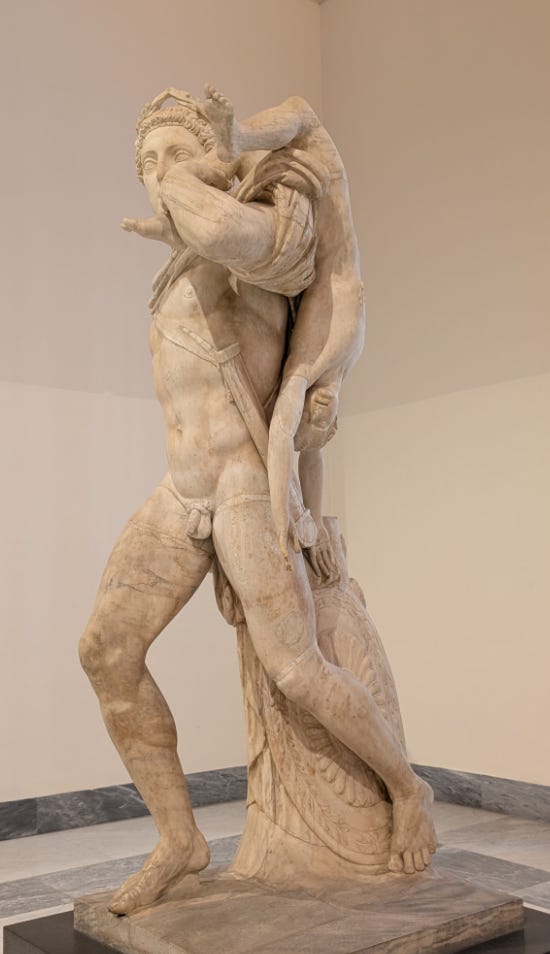
The other was a monumental sculpture of a Greek warrior carrying the body of Astyanax, son of the Trojan prince Hector and his wife Andromache, referring to a story from the Iliad that has always moved me. The warrior is thought to represent either Odysseus or Neoptolemus, Achilles’ son. There was no way to photograph it well, no angle that captured its three-dimensionality.
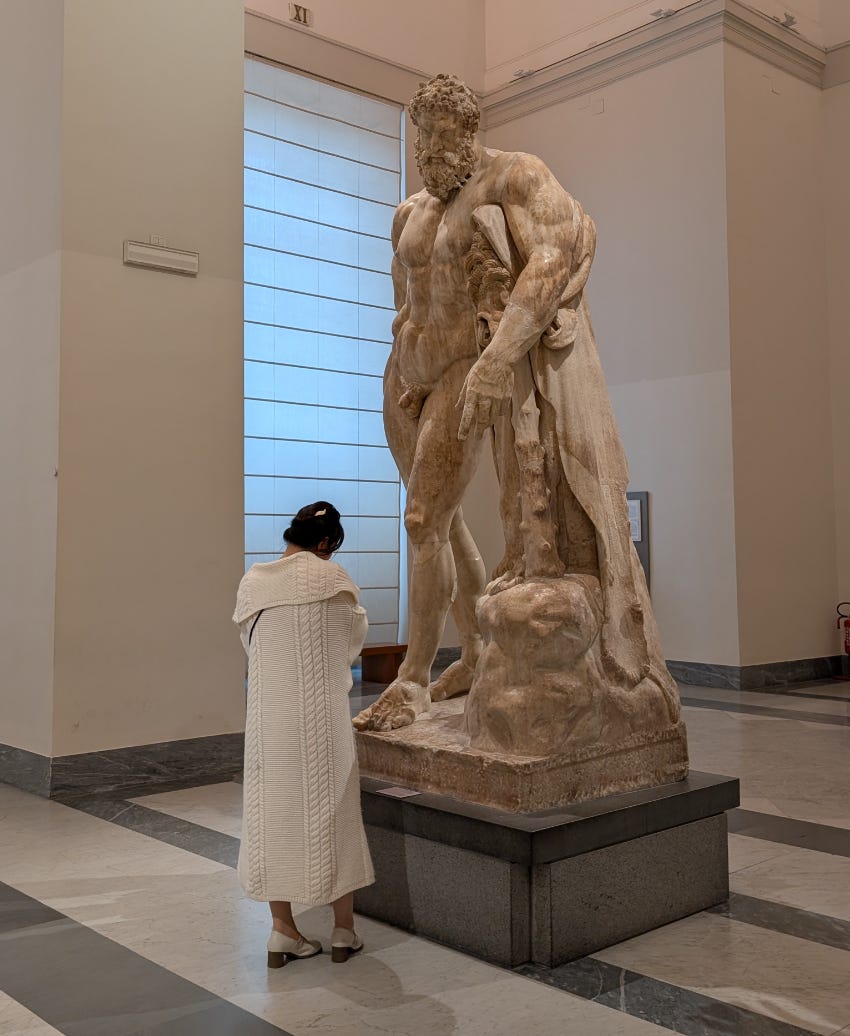
This sculpture was part of a group of huge Roman marble sculptures from the Farnese collection (the same collection that forms the core of the Capodimonte Museum.) In the mid- to late 1500s, twenty or more of these sculptures were arranged around the sides of a bath complex that would have been a major attraction for guests at the Farnese villa. One of the most famous of these is the Hercules, below, with a real person for scale:
This group of sculptures included the Farnese Bull, an enormous, complicated, multi-figured marble sculpture: the largest statue ever discovered from antiquity. It’s a 3rd century Roman copy of a Greek original and was discovered in 1546. At that time, excavations of a known Roman bath had been commissioned by Pope Paul III (Alessandro Farnese), who wanted to find sculptures for the family’s palatial residence in Rome. Michelangelo planned to use it as a fountain. It’s been restored, altered, and added to since then. While I appreciate its complexity, the result we see today is a pastiche of styles and ideas that struck me as confusing and pretty dreadful.
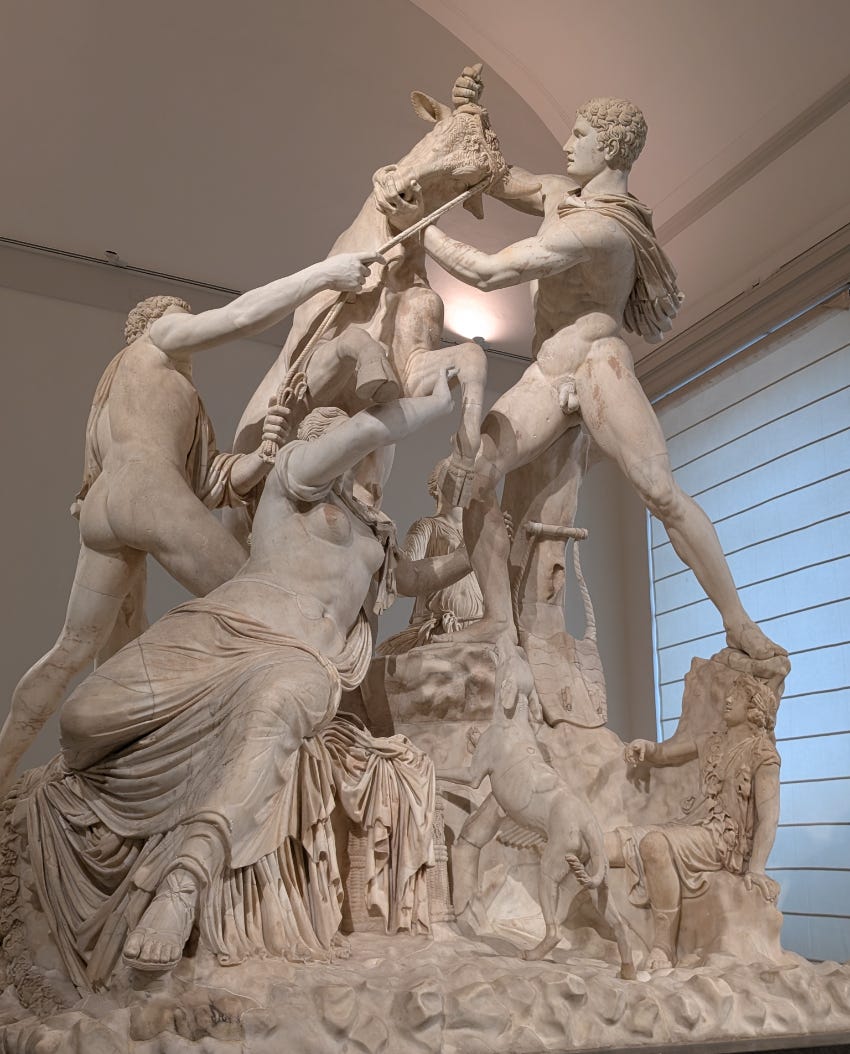
I tried to imagine what that bath complex would have looked like, probably with pools, fountains, and formal gardens, and these huge sculptures lining the outer edges. The grand scale and general excess reminded me of today’s oligarchs, who sadly have wealth but far less aesthetic sense — but it’s the same human impulse to display one’s wealth and power in the largest possible way, and impress this upon others. These people have been with us forever, but will anyone want to fill a museum with the artwork being produced for the oligarchs today?
—to be continued
Man, that Hercules was ripped! :-)
I recently read in The Atlantic an article called “WHAT IF OUR ANCESTORS DIDN’T FEEL ANYTHING LIKE WE DO? The historians who want to know how our ancestors experienced love, anger, fear, and sorrow” - about the historian Rob Boddice.
I’ve been thinking about it a lot, and even more after looking at your photo of the sculpture of a Greek hero with the body of Astyanax slung over his shoulder as if it were nothing. Or equal or less than an animal one had killed for dinner, perhaps. Was it intended to evoke pity? And what did that mean, then? You mentioned that in the 16th C. it was part of a display of statues decorating a bath complex. How did the people who saw this statue experience it?
There is an episode in the Mahabharata about the death of Abhimanyu, son of the hero Arjuna, who was married and soon to be the father of a son, but too young to die. It’s told with great pathos, and there’s a scene later on when his young wife embraces his body on the battlefield, also full of emotion; what did people actually feel about this story?
We will never know, of course. Maybe it’s good to be reminded that not everyone feels as we do. The article mentions public executions, animal fights, every kind of cruelty that people once tolerated and enjoyed - and surprise, probably still do in parts of the world.
Thanks for this post, which helped bring my vague thoughts to a sharp moment of realization, and a wish to explore the matter more deeply.