
July 4th, 2026
Reflections on a Troubled Anniversary

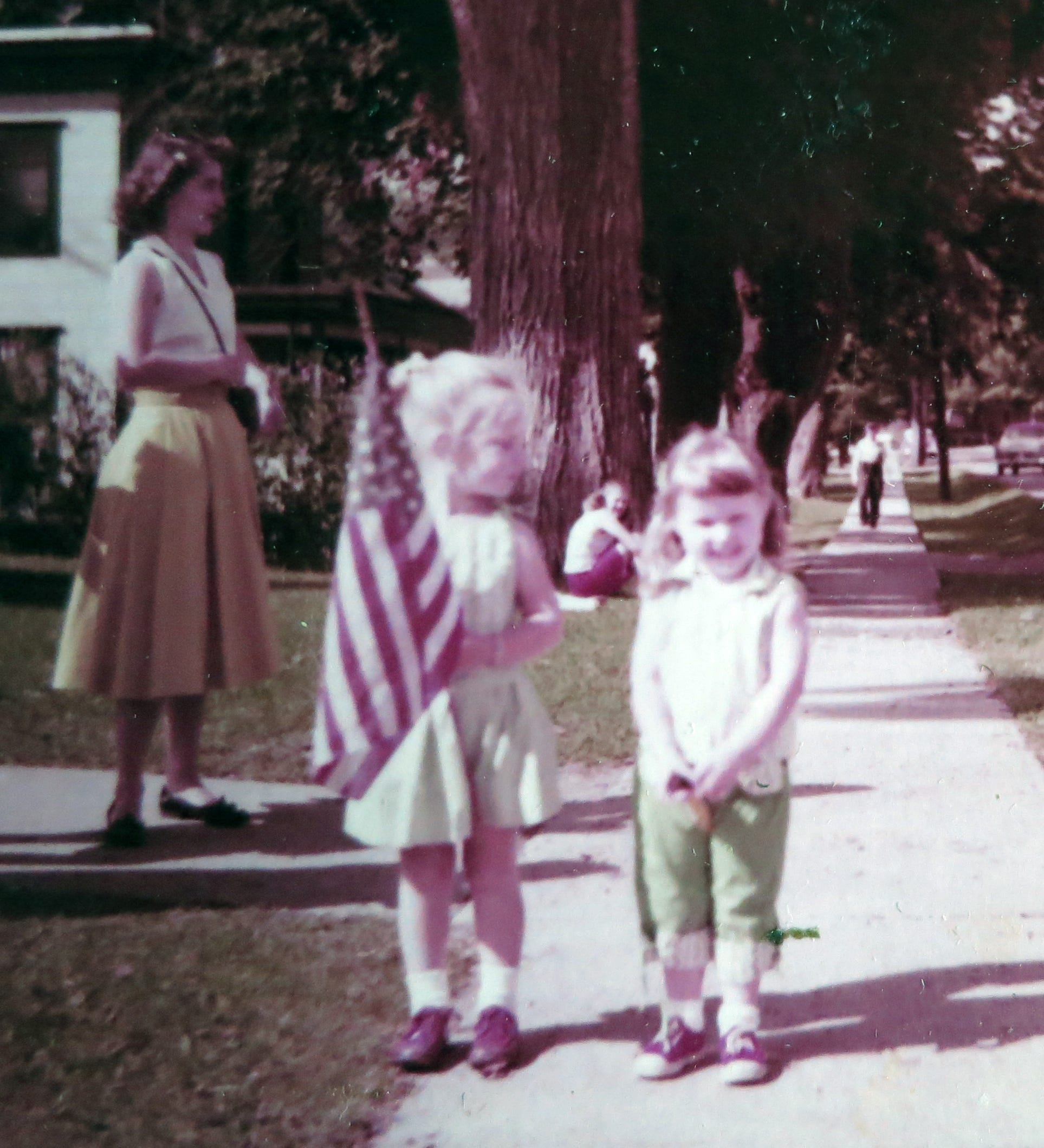
In the 1950s, America was a different place, with a very different feeling. As a little girl (that’s me with the flag, my cousin Barbara on the right, and my mother behind us on the left) I was excited about the parades that took place on holidays in our small town, excited about the sparklers, exploding caps. and small Roman candles that my grandparents brought back from their trips to South Dakota, excited about barbecues and family gatherings. WWII was in the past; my parents’ generation was trying hard to move on, build families, start businesses, coach Little League teams, be happy.
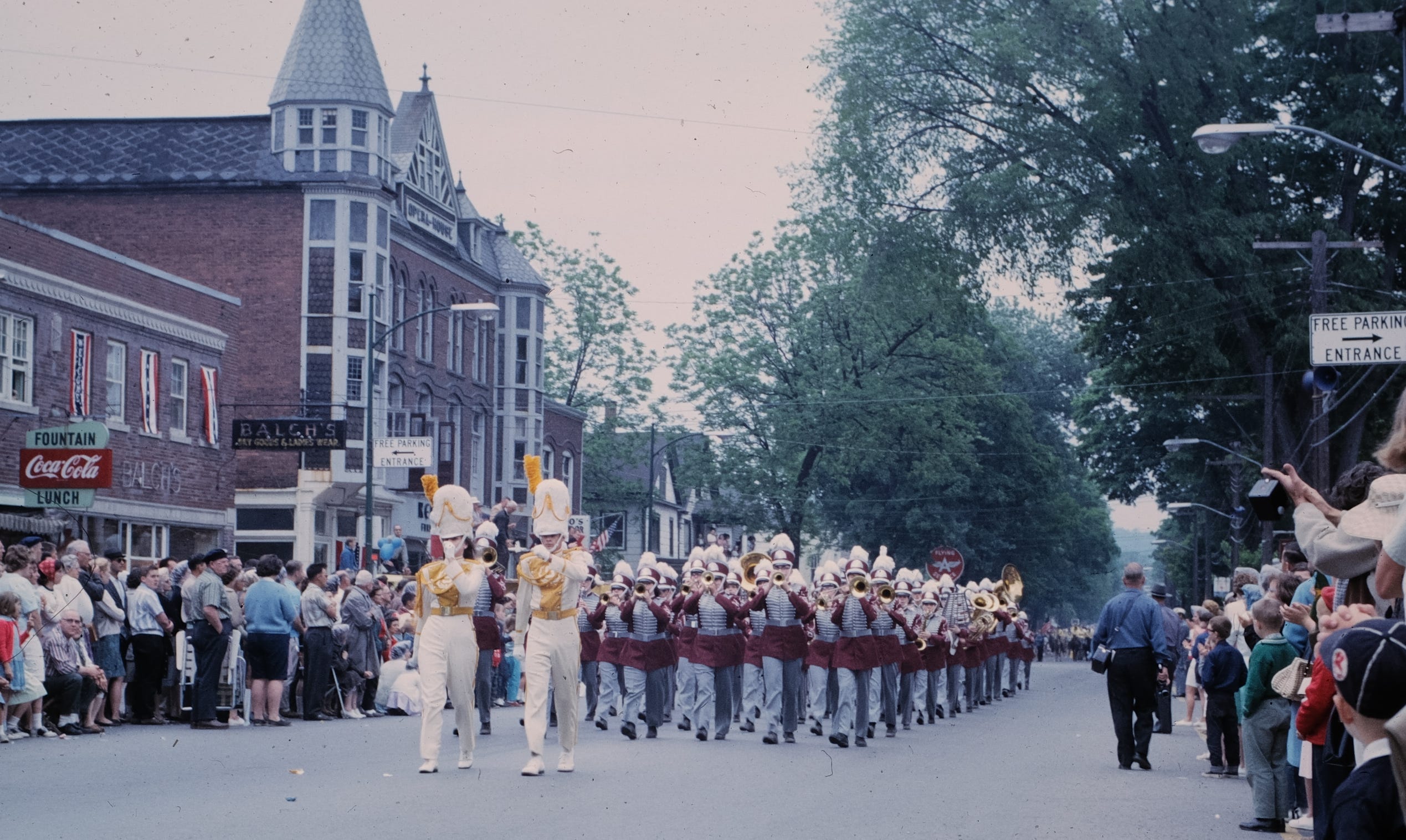
In the background was the Korean War, which ended the year after I was born, and the Cold War arms race that would send those little girls under their school desks in a few years, while air raid sirens split the eardrums of the entire village. Racial inequality was enormous, women had the vote but were far from equal; country clubs, colleges, and organizations discriminated against Jews, and each successive wave of ethnic minorities to immigrate had a hard time assimilating.
In 1957, at age 5, I had no inkling of these complexities, but that would soon change. For my great aunt Inez, an American History teacher, July 4th meant reading the Declaration of Independence and preamble to the Constitution, and telling me stories about the revolutionaries like Paul Revere, who became one of my heroes. She liked to read Longfellow’s poem aloud to me, and I could recite the beginning of it. I had a three-cornered hat, and remember insisting on bandaging my hand in order to emulate the terrible burn he once got from his trade as a silversmith. But American History also meant learning what had happened to the native Americans whose arrowheads still turned up in the plowed fields near my home, and whose partial descendants went to school with me. It meant understanding who the black migrant children were who attended a month of classes with us in elementary school, why the Arab immigrants in my town lived in a segregated area called “the Quarter”, why there was an Irish Catholic church in the county seat as well as an Italian one, and why the one Jewish girl had to sit out in the hallway during weekly “religious education” in our public school, before school prayer was banned in New York State in 1962.
July 4th, though, did feel like a national holiday that brought people together. There were parades and speeches in the morning, and maybe a chicken barbecue, or an ice cream social with a band concert. On the evening of the 4th, we’d sometimes go up to the playing field to watch the town fireworks, but once we had our camps at the lake, our July 4th took place there.
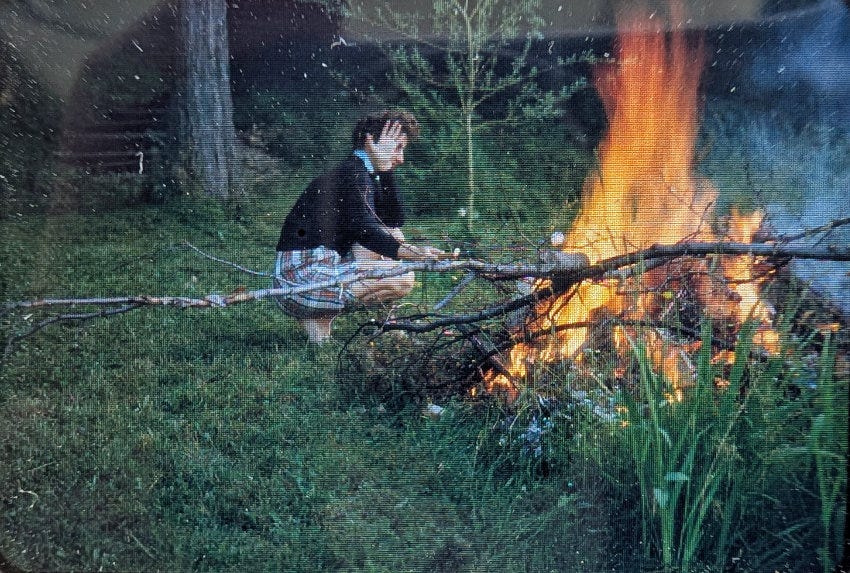
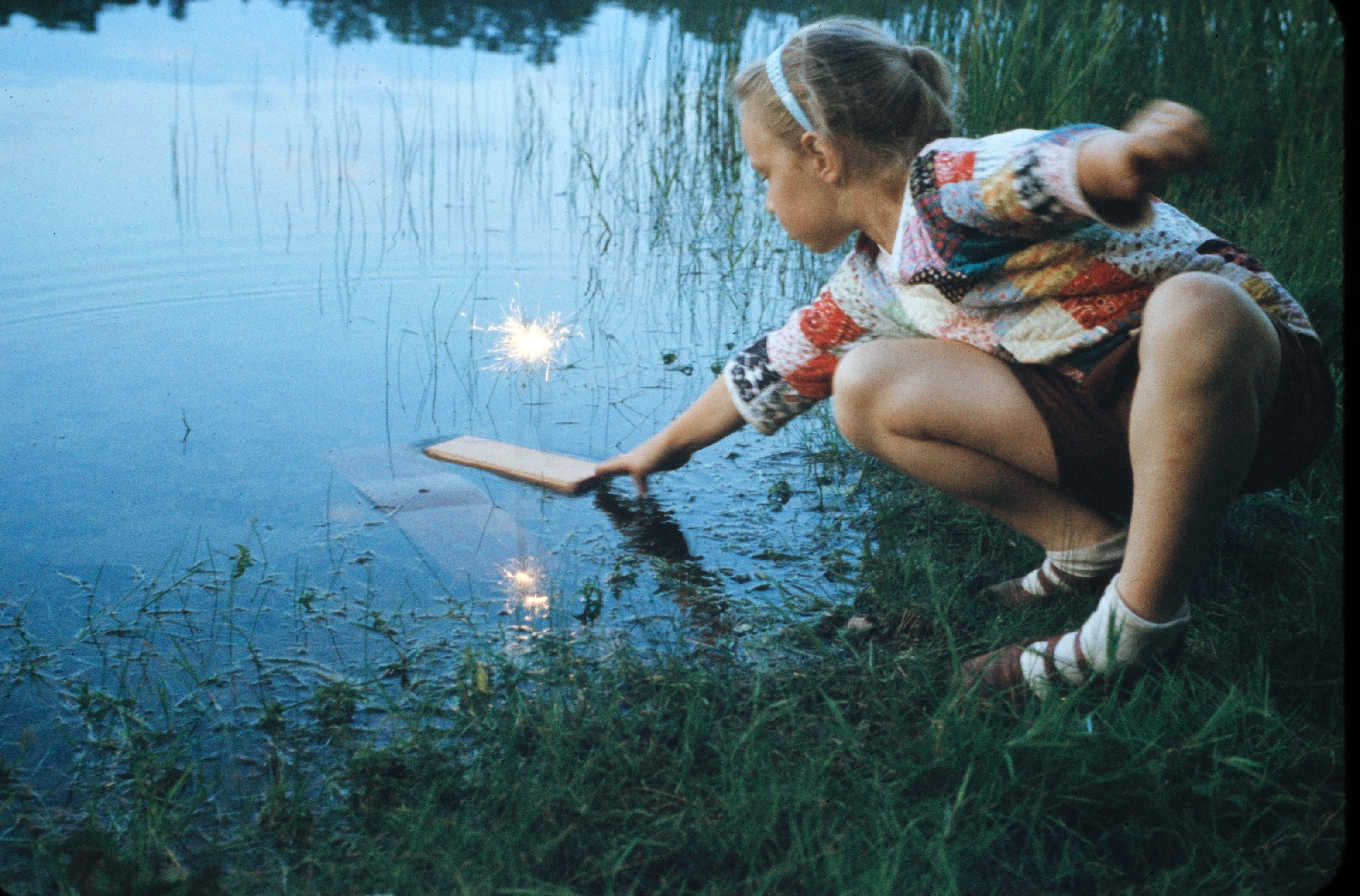
The adults around the lake developed a ritual of bonfires on the shoreline. While marshmallows and quartered peanut butter sandwiches were being toasted, s’mores assembled, and drinks poured, the kids launched little boats holding candles or sparklers that created a magical constellation of lights on the water.
This was the innocent vision of America on its birthday for a northern, small town, white, protestant girl 70 years ago. I grew out of my naïveté quickly, because I learned my history, met people whose backgrounds were starkly different, read voraciously, went off to a big university, and then began to travel to places where my country was viewed quite differently than it was from the inside.
How astonishing it is to me that so many people in America still cling to nostalgia, rooted in the myth of American exceptionalism — an idea that, by its very nature, lives in ignorance and denial, and deflects self-reflection. One of the things it denies is that an idyllic vision of America was open and equally available to all of its citizens.
Friday’s New York Times “World” newsletter speaks about the polarization of the nation on this birthday in an almost neutral way, as if the debate over the direction of the country were a family argument that had nothing to do with its founding principles or Constitution. Then it goes on to say:
I’ve lived my whole life in the Washington area, and on the Fourth of July back in the day, you’d go to the National Mall, bring a picnic, stay through the concert by the National Symphony Orchestra, which would play patriotic music, and then you’d watch the fireworks.
But this year it’s essentially a political rally, and that will leave a lot of Americans feeling that they don’t want to be there. There’s going to be security. They can’t bring chairs or balls or Frisbees or coolers full of food and have a picnic on the mall the way they used to.
Picnics on the mall — what could be more American?
Exactly. You want to look back at what made America great? It was picnics on the mall!
I am sorry, but what made America great was not picnics on the Washington Mall. If America was great, it was because of the blood, sweat, and tears of millions of anonymous workers, soldiers, protesters and organizers who never set foot on the National Mall, but toiled and fought and died for the freedoms that are now being lost.
—-
250 years seems like a lot, but I was taken aback to realize that my own lifetime spans nearly a third of that time. The 100th anniversary was in 1876, the 150th in 1926, when my parents were two years old. I remember the 200th in 1976 very well. By comparison to many world civilizations, whose histories go back for millennia, America is still an adolescent — and the people in charge are behaving that way. To some extent, they always have.
In spite of seeing my country with increasingly open eyes, I grew up proud of its many accomplishments and virtues, so many of which depended on individual people and their freedom to be themselves. Even though I now live in Canada, I will always be American too, and there’s plenty that I’m still proud of, admire, and miss. I am grateful: America gave me opportunity, a good education, mentors and close friends, and small town values that have stayed with me my entire life.
At the same time, I’m filled with shame and sorrow today that this anniversary has been co-opted by people hell-bent on establishing a retrograde, racist, and exclusionary vision of what it should be and what its founders intended, and enriching themselves in the process. How I wish this milestone anniversary could have been a time to take stock, to admit to the failures and tragedies of the past as well as the achievements, and begin a process of self-reflection, reconciliation, and restitution with those who have been so badly harmed, as well as looking forward with realism and hope for all people: created equal, with the right to life, liberty and the pursuit of happiness.
But we are where we are, in history, and right now it’s up to each of us to do that ourselves.
I like the photograph of me launching my little boat of lights as the sun sets. That’s what I want to think about this July 4th, and a good metaphor for who I want to be.
Thank you for your sobering reflections which I've just read at 2:30 a.m. while listening to the blasts of the first of the firecrackers that are exploding illegally inside our small town's city limits. Yesterday I watched "Killers of the Flower Moon" and this morning I woke up at 1:00 a.m. and was unable to go back to sleep. Since the last few years of the Vietnam War, I've been unsettled on the 4th of July after realizing that for some war veterans, the sound of firecrackers triggers PTSD symptoms.
Thank you so much for the image of you and your little boat of lights as I begin to work on this week's Substack post and wait for the sun to rise. That image will be a heartening part of my 4th of July experience from now on.
Beautiful photo.