
Lost

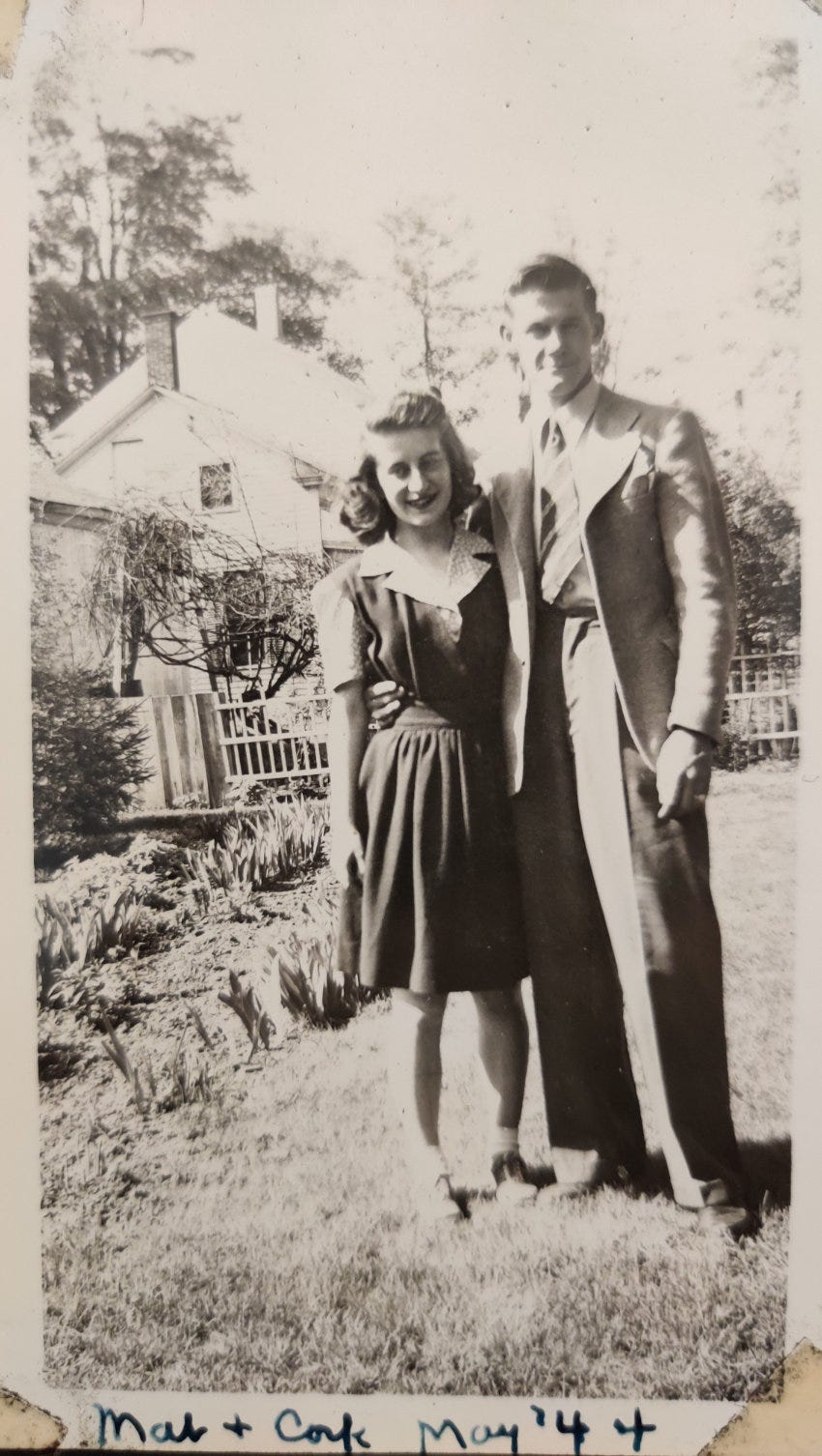
I received a call last week from a dear family friend, a friend of my childhood who spent so much time with us that I thought of him as my big brother. He said he was wondering if I could help him with a question he had. When he went into the Navy many years ago, my mother had given him a scrapbook of photographs from a WWII sailor she had known well — a sailor who “didn’t come home.” My friend now wanted to give the scrapbook to one of the Naval museums, but he didn’t know the name of the sailor who had made it. Did I?
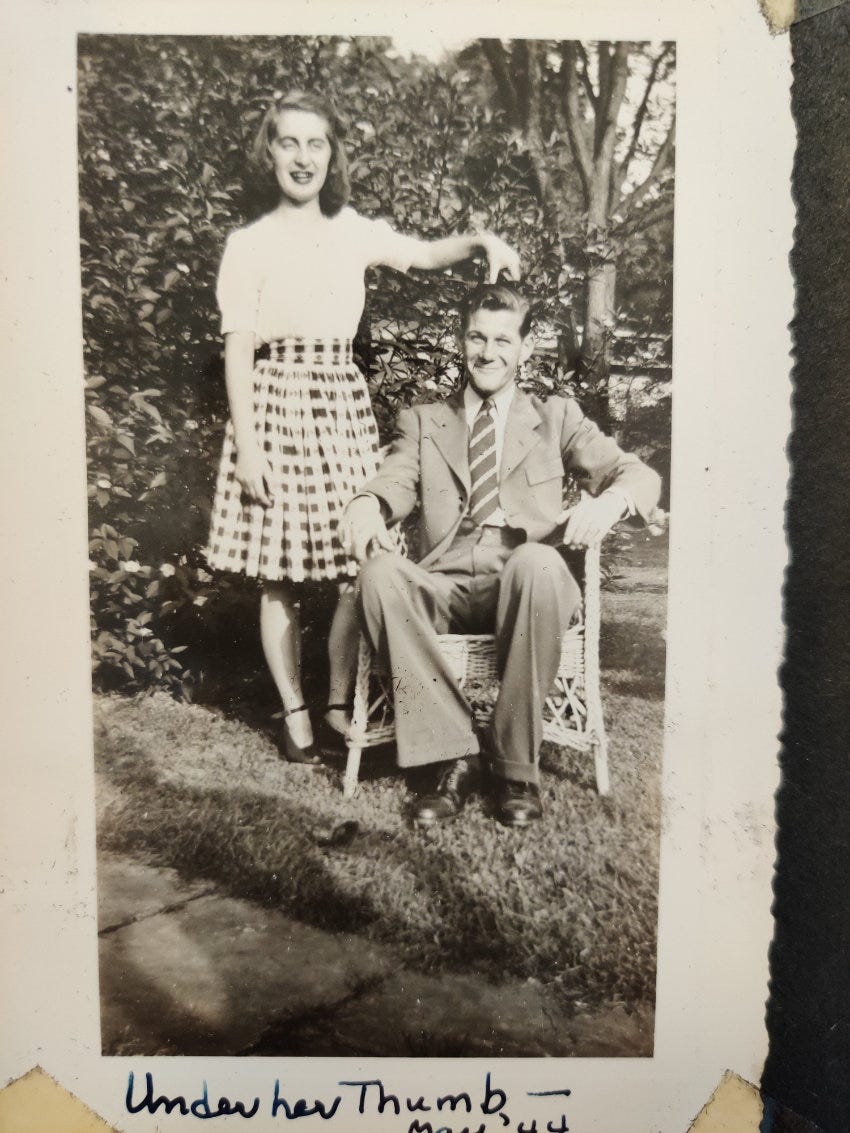
I certainly knew this young man’s nickname, “Corky,” and I knew his face not only from snapshots like these in my grandmother’s album, but from a formal portrait which was always kept in her house along with photographs of the family.
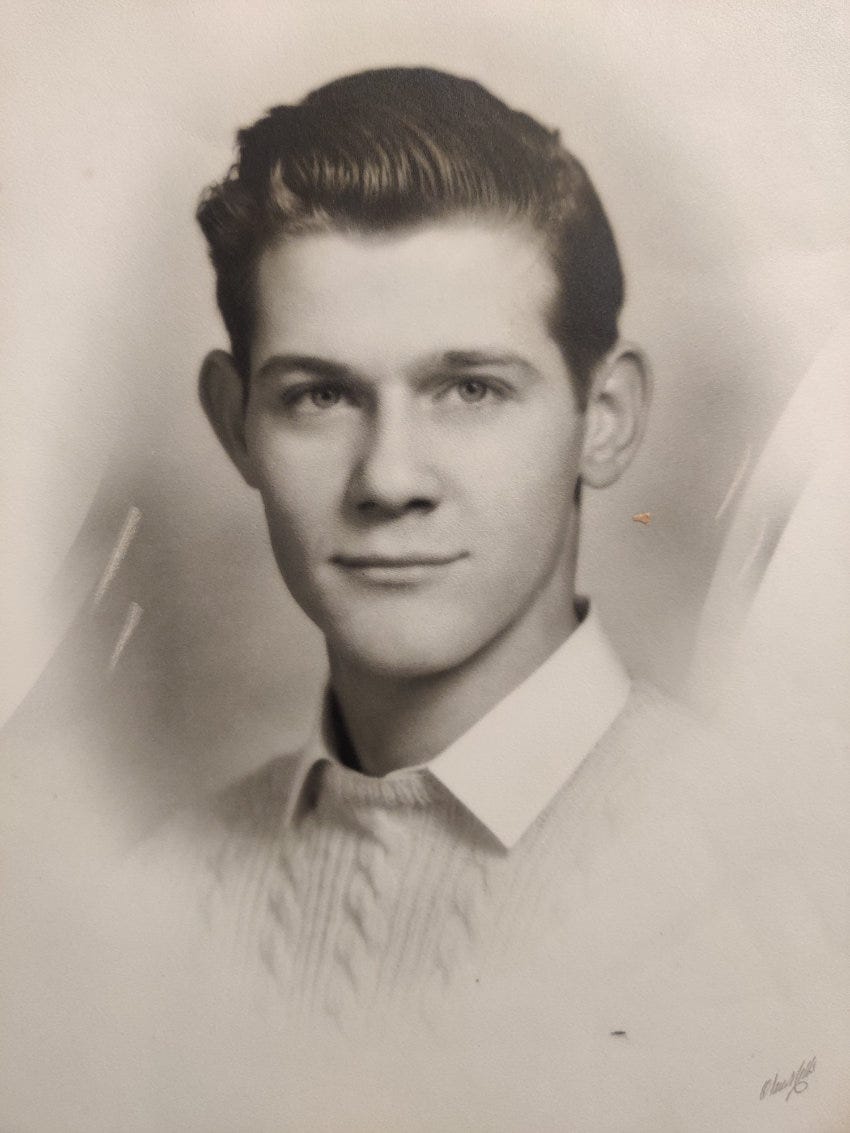
And I knew the outlines of his story: he and my mother were dating; he was loved not only by her but by the whole family; there were several objects in the house that he had brought back from exotic places on his first leave. By the time I was old enough to notice and ask about them, these gifts had become like relics. That young man with the gentle face had never come back from the war; his ship had been lost in the Pacific. My mother, I was told, had taken all of his letters, and some items of clothing he had left with her, and burned them in a bonfire in the backyard. She rarely spoke about him, but it was clear to me that this was a significant grief in her life. It was also the most intimate loss during the war for my family members, during a time when families all over the world were receiving devastating news and mourning those who would never come home.
What I didn’t remember was Corky’s full name, though I knew I had seen it. If this had been a few years ago, my first instinct would have been to call my cousin Barbara. She and her parents had lived in the same tiny upstate New York town Corky had come from; her father and he had been good friends. She would have known his family. My cousin and I were close in age, and had both grown up hearing the same stories of our family’s history, having the same recollections of the photographs in our grandmother’s parlor — and she would have remembered his family name at least.
But in recent years, Barbara began losing her memory. One of the ways I was able to connect with her was to bring over old photo albums that I found while cleaning out my father’s house, some of which had been put together by my grandmother and great aunts. I’d photograph the images I wanted to keep, and then, at the end of the day, take the albums over to Barbara’s house. She loved looking at them, and she would recognize the faces if not the names. We were able to pore over them together, and she’d often ask me, at the end, “Can I keep this? Is this for me?” and I’d always say “Yes, of course.” Now it had been over two years since we had seen each other. In the late fall, she had been moved to a memory care facility near her winter home in Florida.
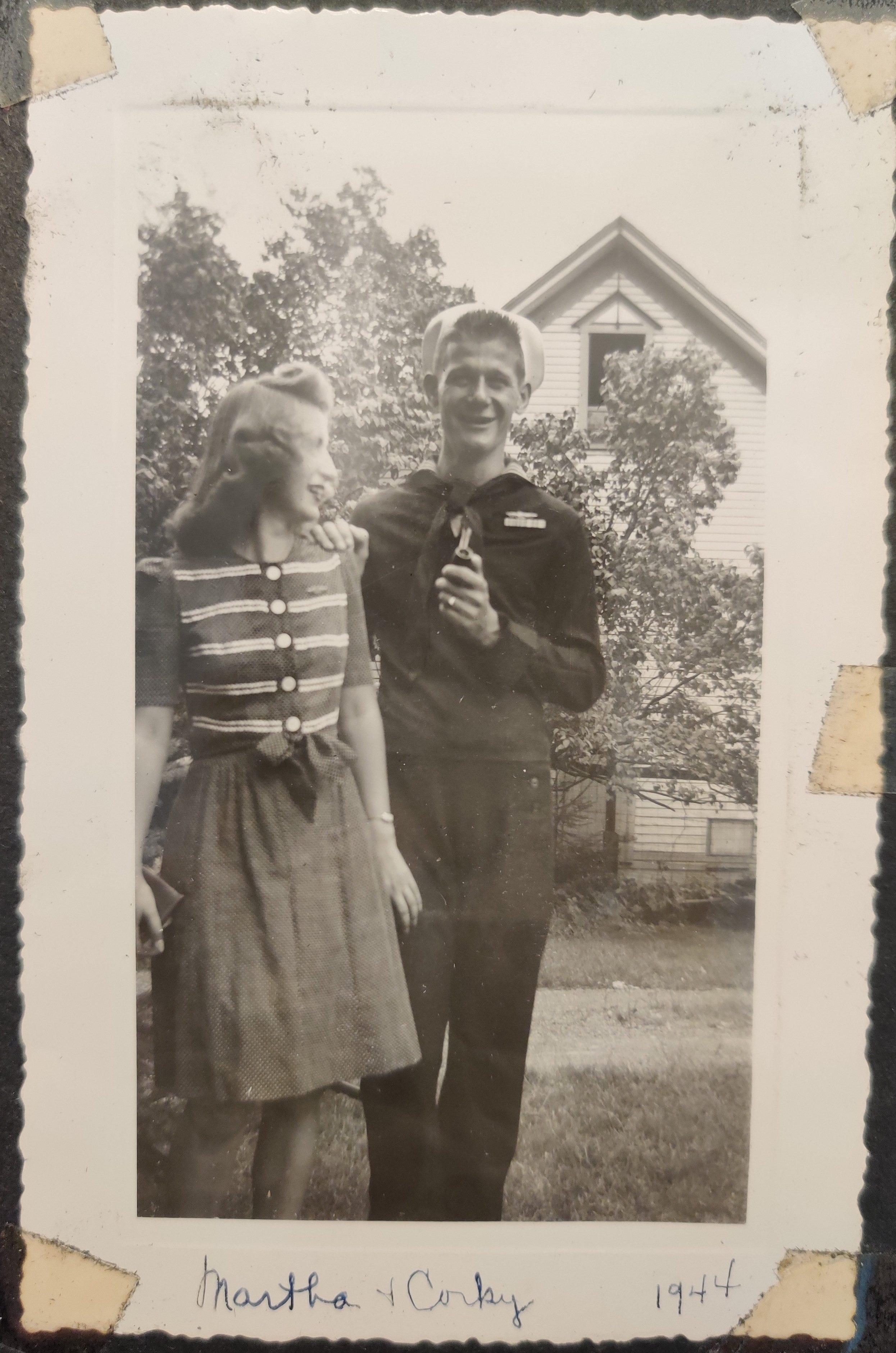
So there was no one to ask about Corky’s name after my friend called. I looked at the photographs I had made of my grandmother’s albums, hoping but not really expecting that his full name might be there. I found these pictures of my mother and Corky together, taken when he must have come home for a short leave. In them, my mother looks more relaxed and happy than in most of the later photographs I have of her. One was labeled “Mat and Cork”, using still-more-shortened nicknames — “Mat” for “Matty” (my mother Martha) and “Cork” for “Corky,” and the date, 1944. In another photo, he wears his naval uniform.
I thought about contacting the high school where my mother and Corky had been students, and asking for a class list, though I wasn’t sure if they had graduated in the same year. I also considered contacting the local newspaper, which would have mentioned his death at some point during the war. I was pretty sure that if I saw his name in a list, I’d recognize it.
Then, I received a second unexpected call: the news that Barbara had died in Florida after a brief and dramatic downturn in her health. All of my four cousins on that side of the family are gone now; the only keeper of the memories is me.
—
My grandmother had made an album quilt for my mother when she graduated from high school. On each white square in the center of the pink and blue calico patchwork blocks, her classmates, friends, and family members had signed their names, which my grandmother then carefully embroidered in blue thread: my grandparents; my great-aunts; my aunt Patty; Barbara’s mother, Aunt Meredith. When we were still using the lake house, we slept under that quilt, which had somehow remained in perfect condition. I knew that Corky’s name was on it, with his first and last names flanking his nickname, in quotes. I could see his handwriting in my mind’s eye, but I just couldn’t bring back the full name. The quilt was packed away, I thought, in our storage unit — I had decided it was too sad to keep using, because all the people who had signed it, including many I had known and loved, were now dead. If all else failed, I’d try to find it.
Then I remembered that my friend had mentioned the name of Corky’s ship. I wrote him back and asked for it: the answer was the USS Kete. So I did an internet search and found more than I expected.
Corky’s vessel was not a destroyer, as I had always thought, but a submarine. In March 1945, ten months after the pictures above were taken, it was on patrol in the East China Sea. During the night of March 10, the Kete sank three Japanese freighters. Four days later, on the 14th, she fired four torpedoes at an enemy vessel that was laying cables in the ocean, but missed. Because the sub had only three torpedoes left, she was ordered to return to Midway Island to refuel, and then to Pearl Harbor to be reloaded with torpedoes. That order was acknowledged on March 19, and on March 20 she sent a weather report from a recorded latitudinal and longitudinal position. Nothing was ever heard from her again. She was declared lost on April 16, 1945.
It’s not known whether the USS Kete perished due to a malfunction, a minefield, or an enemy attack. None of the Japanese records after the war indicated a hit on a US submarine in that section of the ocean during that period of time. One suggested possibility is that she was torpedoed by a Japanese submarine that was also lost before it was able to report the attack. In 1995, deep-sea divers located a wreck off the south-westernmost island of the Okinawa chain. It was speculated that this may be the Kete, but the wreck lies 350 meters deep, and has never been investigated further.
On the next page of the website about the USS Kete was a list of names of the 87 men who went down with her. I took a deep breath and began reading down the list, growing more and more discouraged when none of them seemed familiar. Finally, I came to the next-to-last name: Gordon Weaver Wilson, Torpedoman’s Mate, First Class, Service Number 238 82 92. Yes. I clicked on his name, and there he was:
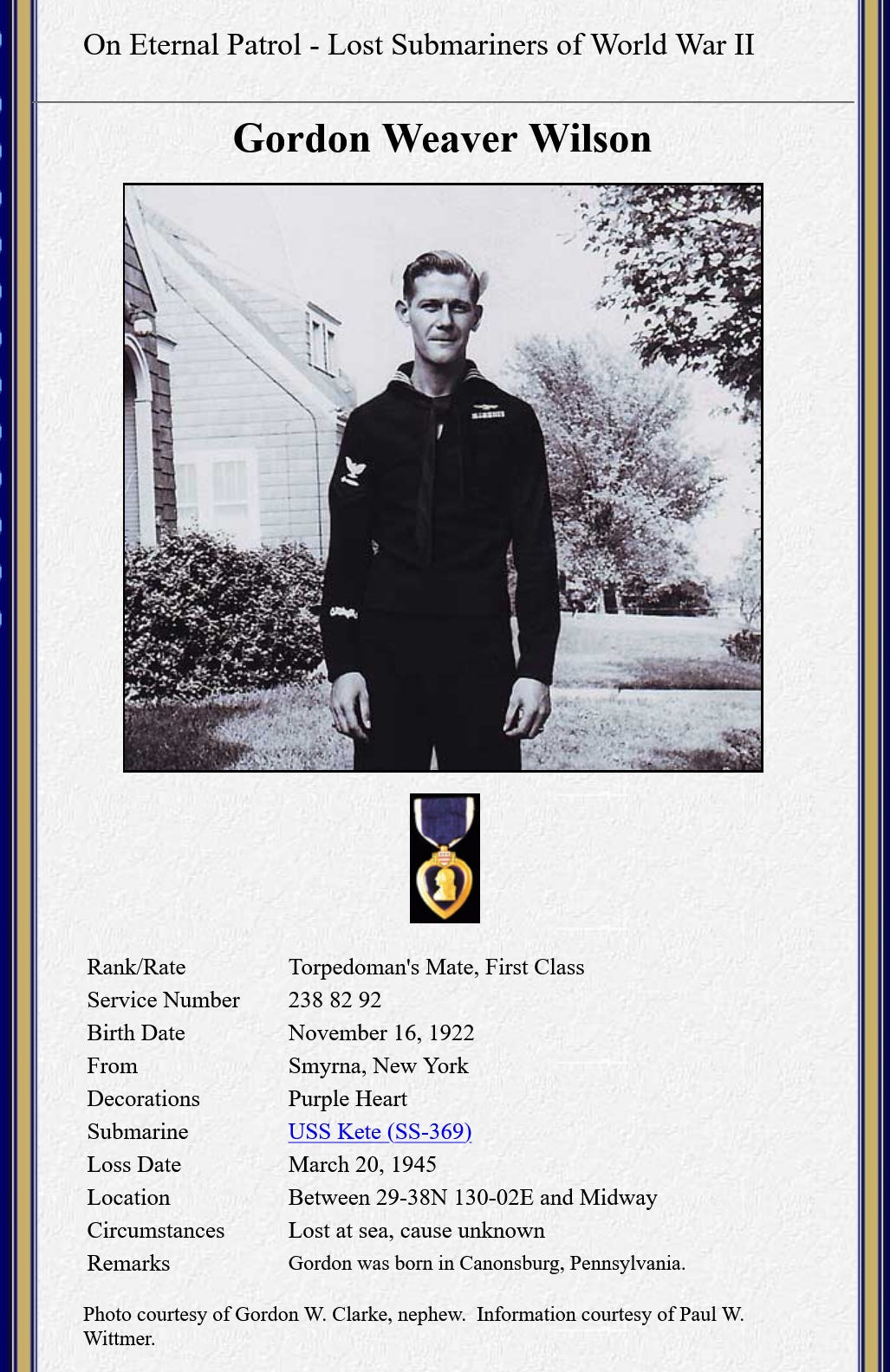
I stared at the photograph for a long time, almost overcome with sadness that shifted from the universal — so many young men just like this, their lives prematurely snuffed out by wars — to the personal: the grief my mother and everyone who knew him must have felt, and the moments of terror he himself must have experienced. Corky, born in 1922, had been two years older than my mother. In 1944, when the last pictures of them had been taken, he was 22 and she was 20, studying ceramics and fine art at Alfred University in western New York State.
If Corky had lived, would he have become my father? But then, of course, I wouldn’t have been me. His tragic death may have opened the path through which my own father, who did survive the war in Europe, could enter. My mother would have been a different person after the war and four years away at college, and perhaps she had different ideas of who she wanted to marry. I knew that she had had another boyfriend during some of those wartime college years — a sculptor and jeweler who, unusually, had been deferred from service, probably for a medical condition. I have a ring that he made for her. She had wanted to go with him to Chicago, but her parents had refused to allow that, so she had no choice but to come back to the small town where she had grown up. And when the war ended, my handsome father, irreverent son of the newly-appointed Methodist minister, and full of life, rode into town on a Harley-Davidson.
—
I wanted to call my cousin Barbara and talk all this over with her. But that conversation, along with many others, was no longer possible.
I keep thinking about the quotation from Ecclesiasticus: "Let us now praise famous men...
There are some of them who have left a name, so that men declare their praise.
And there are some who have no memorial, who have perished as though they had not lived;
they have become as though they had not been born, and so have their children after them.
But these were men of mercy, whose righteous deeds have not been forgotten.
Your memories are luminous and so is the way you crafted this account. Thank you for pointing the way to honouring the life and all the lives that ended too soon.