
The Best Therapy
Knitting comes through again

We’ve been having an interminable and frigid winter up here: the most wintry winter I remember in years and years. Combine long dark days with the continual blizzard of bad news, and rhetoric that ranges from colossally stupid to vindictively hateful, and it’s a prescription for depression. We have to find ways to calm our frayed nervous systems and find some peace. If those deliberate periods of calmness and restoration can also result in something tangible, that’s even better.
Readers here will know that I’m a knitter and sewist. I hadn’t been doing much knitting in the fall, just finishing one hat, but in January I decided to buy wool and start a sweater. I thought I’d be working on it for the next few months, and was planning to take it on our winter trip which starts next week. But between knitting during most of my zoom meetings, and while watching k-dramas or the Olympics at night, or as a stand-alone activity, I not only finished the sweater by the second week in February, but also made a hat afterwards that was a gift. Now I’m feeling a little bereft and empty-handed, wishing I had ordered more yarn.
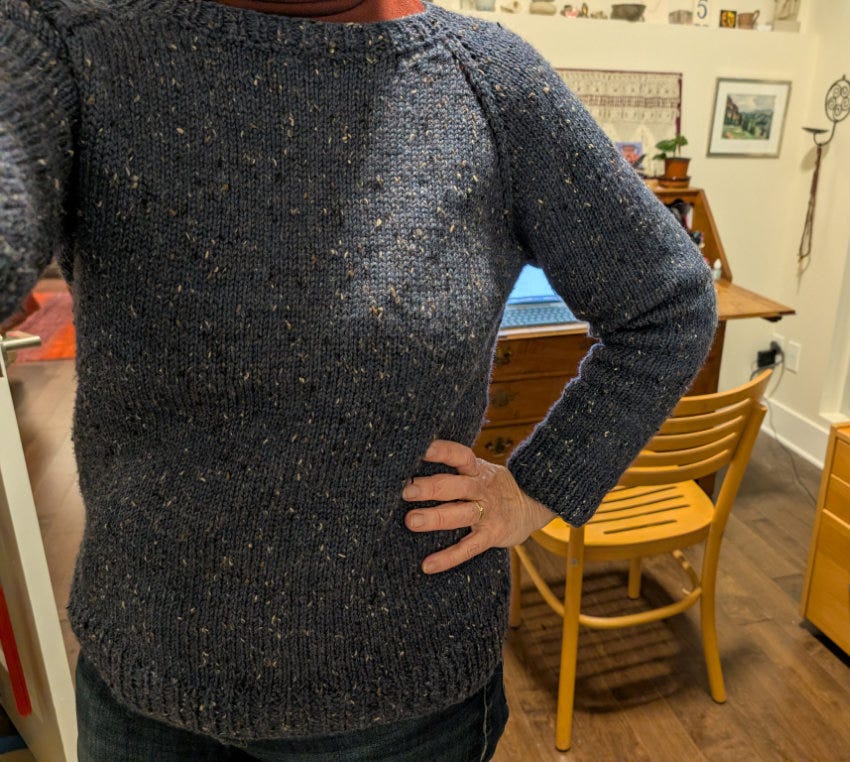
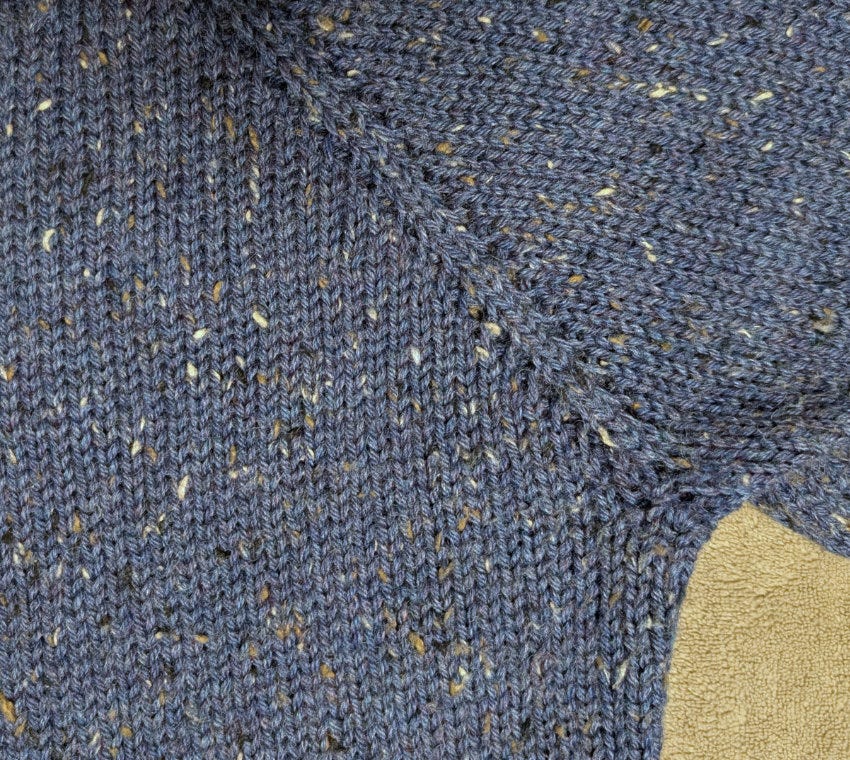
Varleigh sweater, a pattern by Heidi May, here in Wool of the Andes Tweed (worsted weight) from Knit Picks
I cannot recommend this kind of handwork enough. Even if you’ve never tried it, you can go to your local yarn shop and sign up for a class — some libraries offer knitting classes/circles too — and within a few weeks you’ll be able to make a simple scarf. Knitting is not difficult. Or you can use one of the excellent YouTube videos to teach yourself — I always go there when trying to figure out something new to me in knitting instructions. These projects I’ve just done are very simple. It’s the kind of knitting that doesn’t require complicated charts or stitch-counting, and relies on an interesting yarn rather than complex patterns, so that you can work on it while doing something else, or riding in the car or on public transit. Because the sweater was knit in the round, all I had to do for most of it except the ribbing was the knit stitch, which is the simplest of all.
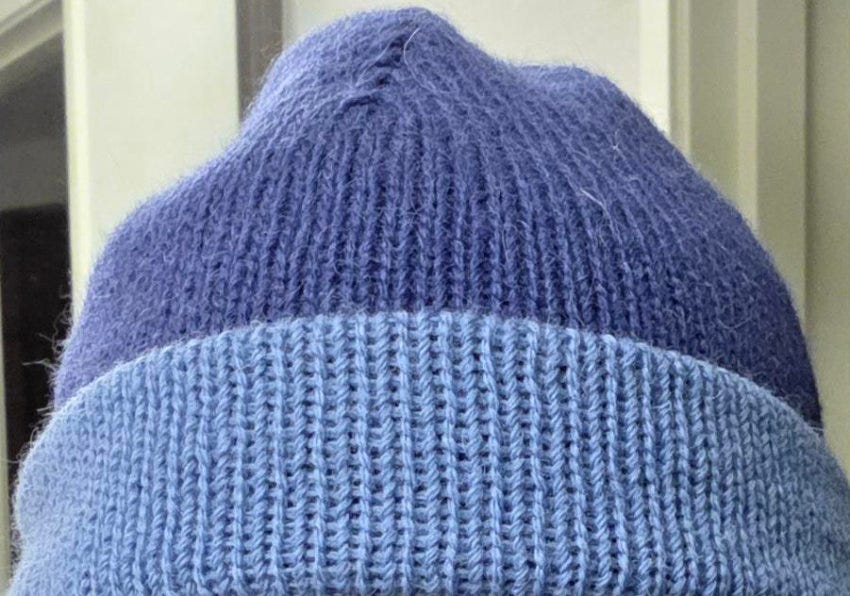
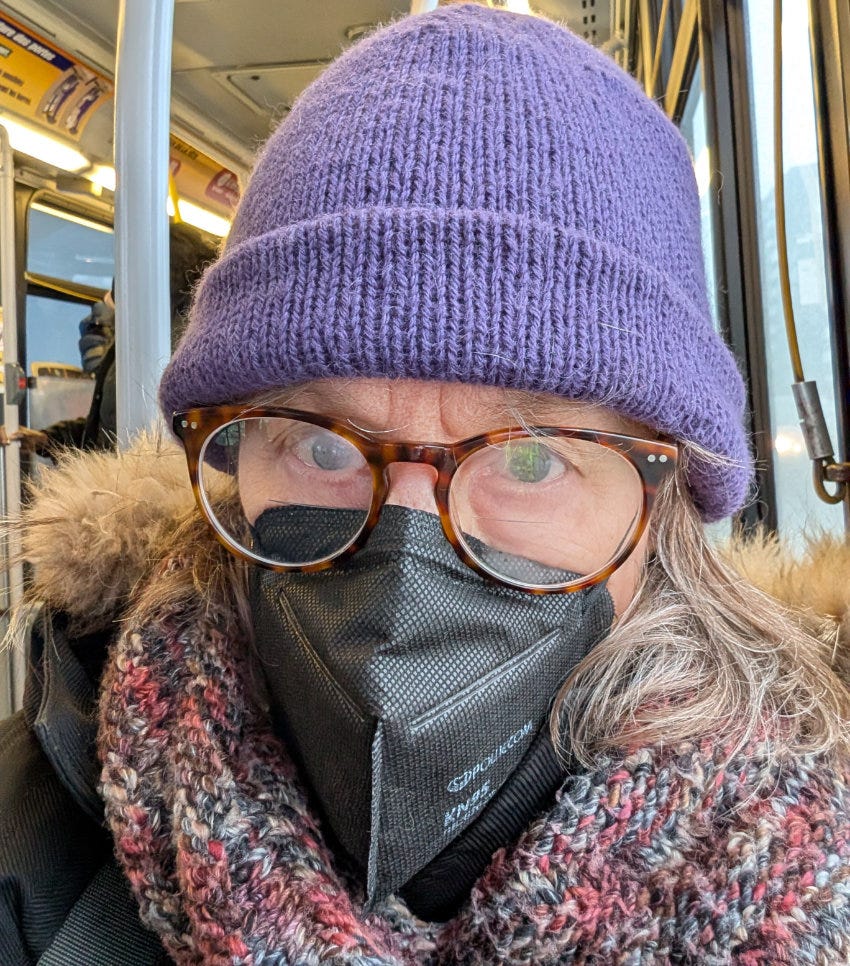
The hats, too, are super simple although getting them started is a bit tricky. You begin with five double-pointed needles, then when enough stitches have been increased, you switch to a circular needle. But it’s still just knit-knit-knit, no purling on the back side. The design, the Cara Hat by Paulastrickt, results in a long tube tapering to a rounded crown on both ends. One half is slipped inside the other to form a double layer, and the open end is turned up to form the brim. I’ve knit four of them now: three in a single color sport-weight alpaca/merino blend (see top photo), and one in two colors (here), so it’s reversible. They’re the warmest hats I have, and very soft and non-itchy.
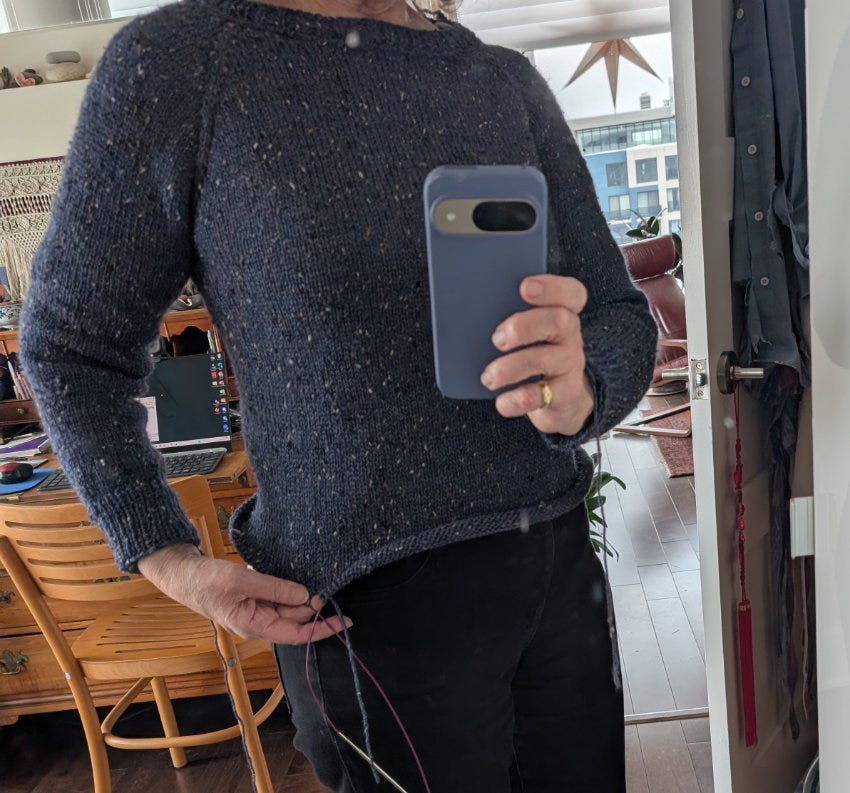
The sweater was knit from the top down, which is my favorite way to make a garment because it allows you to try it on and adjust the fit from the beginning and at any point during the process. The other great advantage is that instead of sewing pieces that have been knit separately together at the end, the resulting garment is entirely seamless.
In this case, I wasn’t sure how much yarn I had, so I knit the sleeves and neck ribbing after making most but not all of the body, and then used the remaining yarn to make the sweater as long as I wanted. My first from-the-top, raglan-sleeve sweater was a cardigan in fine Norwegian wool, made following instructions by knitting expert Barbara Walker, in her book Knitting from the Top (1972) which my friend Judith Esmay lent to me about forty years ago. It was a bible for knitters, explaining the reasons for what you were doing, and allowing you to design your own seamless pattern according to your measurements and how you wanted the sweater to look. Just before I began this sweater, in late December, Barbara Walker died at the age of 95, and I thought about her, and Judith, another expert knitter, as I watched this sweater grow.
The internet has been a boon not only for sourcing yarn, but for patterns by independent designers. I’m happy to support excellent knitwear designers promoting their work and selling their designs directly to knitters, rather than being paid a relatively small amount by a yarn company for a design to be included in a book. Online “knit-alongs” connect knitters who work on a pattern together over a period of weeks or months, sharing problems that come up or learning new techniques, while YouTube videos are there for all of us at any hour of the day or night.
Growing up, I could always run downstairs and ask my grandmother, and later, I’d ask Judith. Neither of them are there anymore, but both passed on to me much more than a craft. Knitting was a meditative, even spiritual, practice that helped both of them be the people they were: generous, calm, kind, productive, and able to weather the storms of life. I’ll always remember Judith exclaiming to me, “I am so grateful for this craft that has given me so much!” — I better understand what she meant with each year that goes by.
My 20-year-old granddaughter and her boyfriend have just taken up knitting as a new hobby. When she showed me her first effort I remembered that I have a bag of knitting wool, some patternsl and many needles. I began to think I too might start a project - and now your post! I think fate is pointing me in an interesting direction! Your sweater is lovely - gorgeous texture and colour and I found your unusual method of construction fascinating.
This is good. I think, as you point out, meditative activities are very needed in these times. The sweater and the hat look great!